
AI Marketing and Advertising
How to Advertise on ChatGPT in 2026: A Small Business Guide to AI Conversational Ads
By ProAccess Team, ProAccess.me · 23 October 2026 · 8 min read
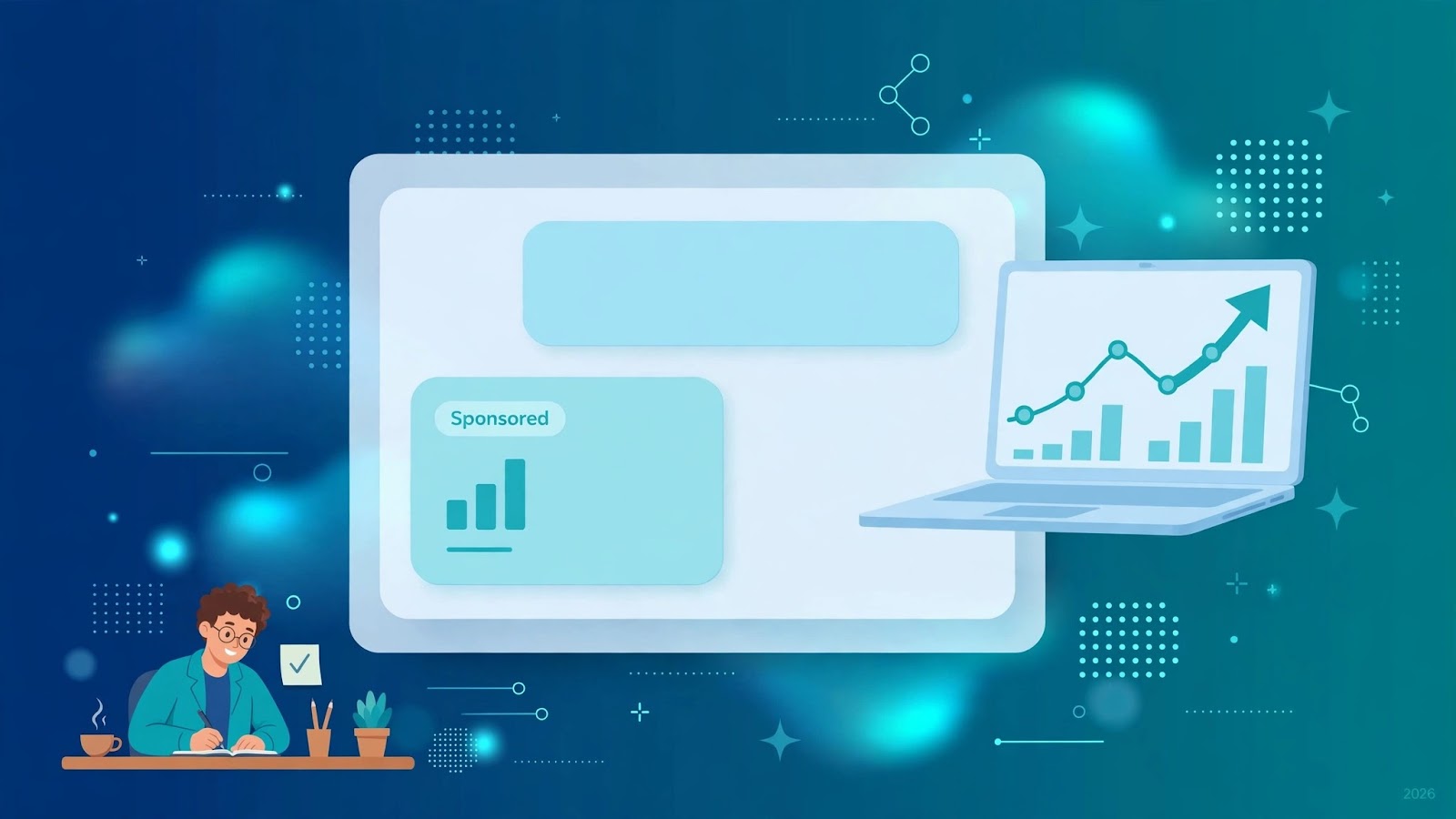
Imagine a customer typing, "What's the best email marketing tool for a small bakery?" — and right below the AI's answer, your product appears, clearly labeled, at the exact moment someone is ready to buy. That's conversational advertising, and in October 2026 it became a lot more accessible: OpenAI expanded ChatGPT ads to 26 more countries, bringing the total to 89, while the ads business crossed a $1 billion annualized revenue run rate with more than 100,000 advertisers having run campaigns. For small businesses and freelancers, this is a brand-new channel where buying intent is built right into the context. This guide explains how to advertise on ChatGPT in 2026 — what it is, how it works, what it costs, and how to launch your first campaign.
What Are ChatGPT Ads?
ChatGPT Ads are paid placements that appear below the AI's answers in a conversation. They are clearly labeled as sponsored, so users always know what is an ad and what is the AI's response. OpenAI has been explicit on one critical point: ads do not influence what the model says. Your ad sits next to the answer, never inside it.
Think of them less like banner ads and more like sponsorships tied to intent. Someone asks a question; the AI answers; a relevant advertiser gets a clearly marked slot underneath. The context is the targeting.
Who sees the ads?
Ads appear only for users on the Free and Go tiers. Plus, Pro, and Enterprise subscribers get an ad-free experience, and ads are shown to logged-in adult users. That's the inventory in practice — a huge free-tier audience plus the new Go segment, with premium subscribers excluded.
How ChatGPT Ads Work
The mechanics are refreshingly straightforward compared to traditional ad platforms:
- Context-hint matching: Instead of cookies or personal tracking, ads are matched to conversations using contextual signals — the topic of the conversation determines which ads are relevant.
- Self-serve Ads Manager: Since May 2026, businesses can buy ads through OpenAI's self-serve Ads Manager. Advertisers in newer markets can also buy through technology partners while self-serve rolls out.
- Clearly labeled placement: Every ad is marked as sponsored and appears below the answer, separate from the AI's response.
The timeline shows how fast this has matured: OpenAI announced ChatGPT ads testing in January 2026, the US pilot began in February, the self-serve Ads Manager opened to all US businesses in May, AI-powered creative tools launched in September, and India went live in August 2026 with over 100 million weekly users and more than 50 brands running through agency partners WPP and Omnicom.
How Much Do ChatGPT Ads Cost?
Here's the honest answer: OpenAI has not published fixed pricing, CPC, or CPM figures for ChatGPT Ads. The platform works on a self-serve model where you set a budget and bid for placements, in the same general spirit as other self-serve ad platforms — but anyone quoting you exact rates is guessing.
What you can control is your spend floor. Self-serve means you decide the budget, test with a small amount, watch what happens, and scale only when the numbers make sense for your business. For a small business, that means starting with a modest test budget on a tightly defined topic area and treating the first run as a learning experiment, not a revenue event.
Who Can Advertise?
After the October 21, 2026 expansion, advertisers in 89 countries can run ChatGPT ads, including India. Advertisers in the newest markets can buy through technology partners or through self-serve Ads Manager access. Eligibility basics are simple: you need a business, compliant creative, and an Ads Manager account — but check the current Ads Manager documentation, because eligibility rules and creative policies are still being refined as the platform grows.
Step-by-Step: Launching Your First Campaign
1. Define the question your customer is asking
Conversational ads are matched to conversation context, so start from the user's question, not your product pitch. List 10–15 real questions your ideal customer asks an AI — "how to send bulk emails for a small shop," "best affordable CRM for freelancers," "where to buy digital tools cheaply" — and build your campaign around those.
2. Set up your Ads Manager account
Sign up for self-serve access through OpenAI's Ads Manager (or a technology partner in your market). Complete business verification and set your billing details before you build anything.
3. Create your creative
Write clear, honest ad copy that reads well underneath an AI answer. OpenAI introduced AI-powered creative tools for advertisers in September 2026 — and note the fine print: advertisers get a window to opt out of automatic creative rewrites. Keep your claims verifiable and your branding unmistakable.
4. Choose your context hints
This is the targeting step: you choose the conversational contexts where your ad should appear. The more precisely your product answers the user's underlying question, the better the fit.
5. Set a test budget and launch
Start small. Pick one tight topic cluster, set a modest budget, and run for a week or two. Then measure: what did you spend, what happened, and did it beat your other channels?
6. Measure and iterate
Track the metrics Ads Manager gives you, and compare cost per result against your existing channels. Kill what's not working, double down on the contexts that convert.
AI Tools for Advertisers
OpenAI's September 2026 advertiser tooling added AI-powered creative assistance — the platform can help generate or refine ad copy. Treat these tools as a first draft, not a final answer: review every AI-generated line for accuracy, tone, and compliance before it goes live, and decide deliberately whether to let the platform auto-rewrite your creative (you'll be given days to opt out).
Pairing ChatGPT Ads With Your Marketing Stack
An ad click is only the beginning. Conversational ads generate high-intent curiosity — someone asking an AI about your product category is warm — but you'll only get value from that click if your follow-up stack is ready. Three pieces matter most:
Email follow-up. Send every ad-driven visitor to a landing page with a clear email capture, then nurture them. A lifecycle email flow turns one curious click into a relationship — platforms like Customer.io Essentials are built for exactly this kind of automated follow-up.
Amplify with direct channels. Conversational ads are new and unproven; proven channels still carry the load. Pair your AI ad experiments with direct advertising where you control the message and the audience — for example, Advertise Email lets you put your offer in front of engaged email audiences while you test how the conversational channel performs.
Feed the top of the funnel. The broader your prospect base, the more useful your experiments become. A Leads Database can help you build and segment prospect lists to retarget alongside your AI ad campaigns, so every test teaches you something about real buyers.
One caution: keep your claims honest everywhere. Conversational ads sit next to AI answers that users trust — don't borrow that trust with exaggerated promises.
Pros and Cons for Small Businesses
| Pros | Cons |
|---|---|
| Meet customers at the moment of intent — the question is the targeting | No published pricing — you're testing into the unknown |
| Huge and growing free-tier audience across 89 countries | Premium (Plus/Pro/Enterprise) users never see your ads |
| Self-serve model with full budget control | Young platform — policies, tools, and reporting are still evolving |
| Clear labeling keeps the format trustworthy | Context matching is less precise than keyword bidding for niche products |
| First-mover advantage while competition is still light | Only 100,000+ advertisers so far — early data is limited |
FAQ
Do ChatGPT ads influence what the AI says?
No. OpenAI has stated that advertising does not influence the model's responses. Ads appear below answers, clearly labeled, and the AI's output stays independent of advertiser spend.
Who sees ChatGPT ads?
Only users on the Free and Go tiers see ads. Plus, Pro, and Enterprise subscribers are ad-free, and ads are shown to logged-in adult users.
Can businesses in India advertise on ChatGPT?
Yes — ChatGPT Ads launched in India in August 2026 with over 100 million weekly users, and the October 21 expansion brought the total to 89 countries. Indian advertisers can buy through agency partners or self-serve Ads Manager.
How is privacy handled?
OpenAI says ads are matched using contextual conversation signals rather than personal tracking, and advertisers don't see individual conversations. Review the current Ads Manager documentation, since privacy policies are still being refined.
What comes next?
Watch sponsored agents — business-backed AI assistants that OpenAI began testing with select US advertisers in September 2026. If they open up broadly, they could become the most powerful conversational ad format for small businesses.
Conclusion
Conversational intent is the next frontier of digital advertising. ChatGPT ads — now live in 89 countries, growing past a $1B revenue run rate — let a small business appear at the exact moment someone asks the right question. The playbook is simple: start with the customer's real questions, set a small test budget, pair the clicks with solid email follow-up, and measure honestly against your other channels. If you're ready to start, check out affordable marketing tools at ProAccess.me — and run your first AI ad experiment this week.
FAQ
Do ChatGPT ads influence what the AI says in its answers?
No. OpenAI has stated clearly that advertising does not influence the model's responses. Ads appear separately, below answers, and are clearly labeled as sponsored. The AI's answers remain independent of advertiser spend.
Who actually sees ChatGPT ads?
Ads are shown only to users on the Free and Go tiers. Plus, Pro, and Enterprise subscribers get an ad-free experience. Ads also appear only for logged-in adult users.
Can businesses in India advertise on ChatGPT?
Yes. ChatGPT Ads went live in India in August 2026 with over 100 million weekly users in the country, and OpenAI's October 21, 2026 expansion brought the total to 89 countries. Advertisers in India can access campaigns through agency partners or self-serve Ads Manager.
How much does it cost to advertise on ChatGPT?
OpenAI has not published detailed public pricing or fixed CPC/CPM figures. The platform operates on a self-serve Ads Manager model where advertisers set budgets and bid for placements, similar in spirit to other self-serve ad platforms. Costs vary with competition, targeting, and creative quality.
Are ChatGPT ads safe for user privacy?
OpenAI says ads are matched to conversations using contextual signals rather than personal tracking, and advertisers do not see individual conversations. If you're running campaigns, review the current Ads Manager privacy documentation, as policies are still being refined.
What are sponsored agents, and should small businesses care?
Sponsored agents are business-backed AI assistants that OpenAI began testing with select U.S. advertisers in September 2026. They could eventually let a brand offer a helpful assistant inside ChatGPT. For now they're in testing only, but small businesses should watch this space — it may become the most powerful conversational ad format of all.
Looking for premium tools?
Browse ProAccess store